Giving every hydropower plant a common language
The problem: 1,600 power plants that don’t speak to each other
Norway has more than 1,600 hydroelectric power plants, and together they produce over 90% of the country’s electricity. Many of them are also old: across Europe, nearly 60% of hydropower plants are more than 40 years old, and Norway is no exception. Over decades of operation, turbines get refurbished, generators get replaced, sensors get added, and each plant ends up with its own private vocabulary for describing its own equipment.
That sounds like a minor bookkeeping issue until you hear the number an engineer at Statkraft once quoted: a single type of bearing, of the kind installed in hydropower stations across the country, was being described using 427 different names for its 11 signals. Multiply that across a fleet of plants built in different decades by different manufacturers, and it becomes clear why “just add AI” is not a realistic plan for predictive maintenance at scale. You cannot build one analytics model and expect it to work everywhere if every plant calls its own thrust bearing something different.
This is the problem WP1 set out to fix: not a specific fault or a specific machine, but the underlying data plumbing that every other work package in PHMHydro depends on.
A generalised naming system
The starting point is a piece of infrastructure that sounds dry but is doing real work: the international standard ISO 81346, and specifically its 2022 extension for power supply systems, known as RDS-PS. It gives every component in a plant, from the turbine down to a single accelerometer on a bearing, a structured code built from letters. A one-letter code marks a high-level system, two letters a mid-level system, three letters a specific component, and prefixes mark whether you are describing what something does (function), what it is (product), or where it sits (location).
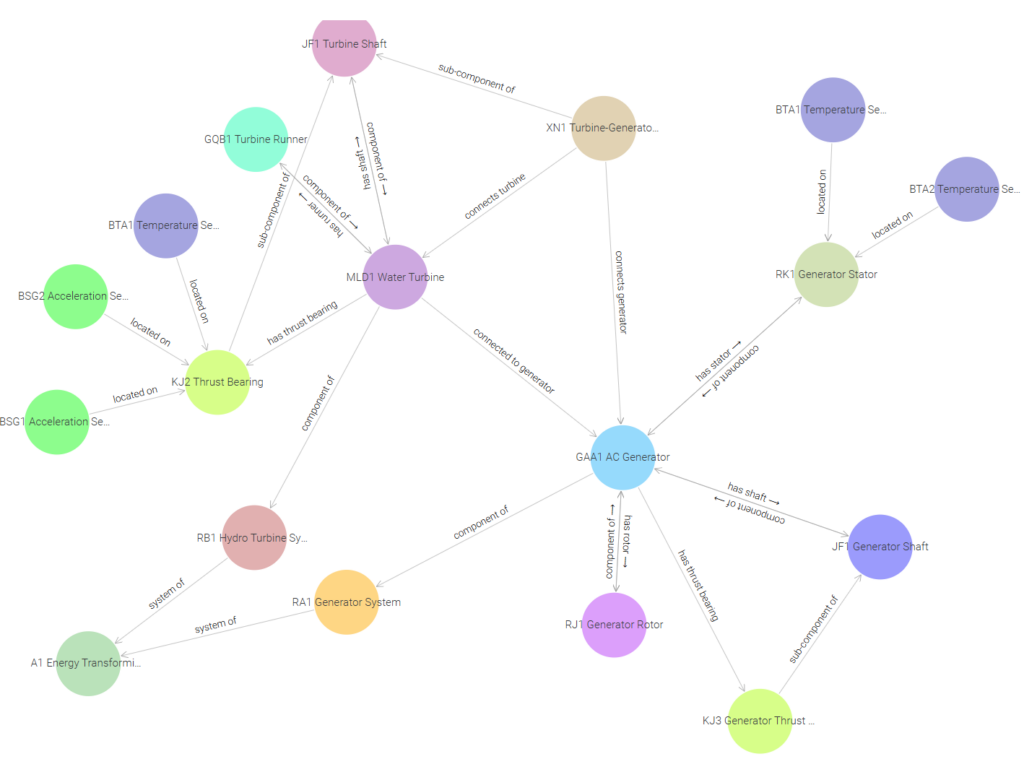
An accelerometer sitting on the guide bearing of a turbine shaft, for instance, gets the tag `=A1.RB1.MLD1.JF1.KJ1.BSG1`. It looks cryptic, but every part of that code is doing something useful: it tells you it belongs to the power-generating system, the turbine subsystem, the specific turbine, its shaft, the bearing on that shaft, and finally the sensor itself. Crucially, that same tag structure means a bearing is always `KJ`, whether it is in a Kaplan turbine in Norway or a completely different machine elsewhere. Norway has tried this before with other naming schemes (RDS-PP, the EBL code plan, NEK 321-322), and all of them have since been withdrawn or fallen out of favour. RDS-PS, backed by Fornybar Norge’s RDS-Hydro initiative and now formalised in ISO 81346-10:2022, is the candidate the team argues is finally fit for purpose, and the research investigated its practical application to a real Norwegian hydropower plant, mapping out how turbine, generator, and civil structures should be tagged under the new system.
Turning tags into a map a machine can reason over
A naming convention alone does not run analytics. The second half of WP1’s work turns those RDS tags into a knowledge graph: a structured, machine-readable map of the plant where every piece of equipment is a node, and the relationships between them (system-of, component-of, located-on) are the connections. Each node also carries attributes such as manufacturer, serial number, install date, and operational status, and a validation layer called SHACL enforces rules like “every turbine must have a shaft and a rotor” so the graph cannot silently go incomplete or inconsistent.
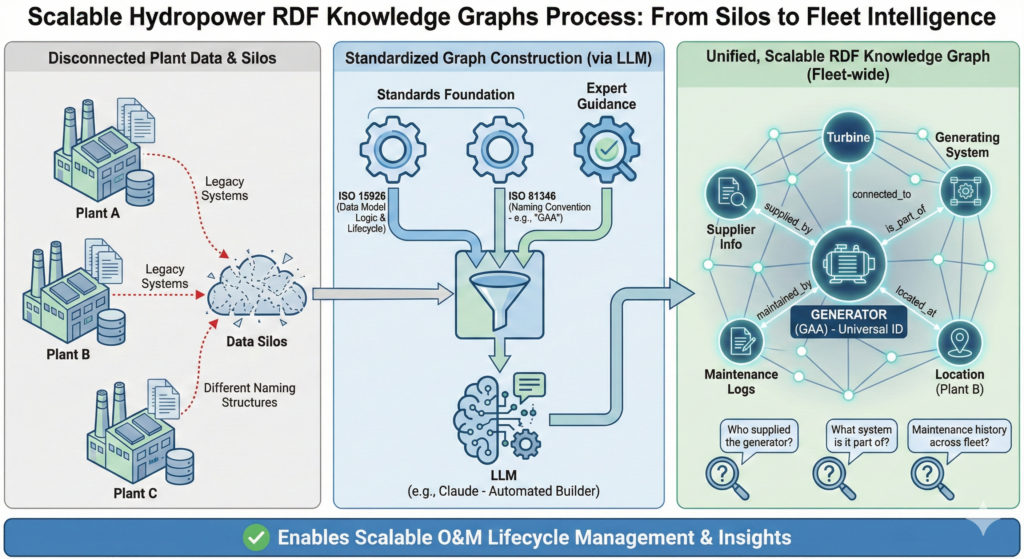
Building such a graph by hand is exactly the kind of tedious, error-prone work that discourages plants from ever bothering. So the team tested whether a large language model, guided by the RDS rulebook itself, could generate the graph automatically. Working with Claude Sonnet and feeding it the ISO 81346 and ISO 15926 documentation as reference material (a technique called retrieval-augmented generation), the researchers had the model construct the graph interactively: first the equipment hierarchy, then the technical attributes, then the SHACL validation rules.
The case study used a real run-of-river plant in southern Norway, built around a 55 MW Kaplan turbine and its synchronous generator. Eighty-nine equipment tags, 17 equipment classes, roughly 280 graph relationships, and more than 60 validation rules were generated by the model in about 20 minutes of active graph-building, on top of roughly 70 minutes spent teaching the model the tagging conventions. The output was 100% compliant with the RDS standard and better than 95% accurate against manual checks. The team’s own estimate for doing the same job by hand: upwards of 40 hours.
HydroAssist: Bringing asset intelligence to O&M personnel
A well-organised map of a plant is useful, but most operators will never write a query against it. A shift operator who wants to know whether the thrust bearing is running warmer than it used to does not want to write database queries or a script. They want to ask the question in plain language and get an answer they can trust. This is what HydroAssist, a prototype assistant built on top of the knowledge graph, is designed to do.
You type something like “How are the thrust bearing temperatures behaving this month, and is anything drifting?” HydroAssist works out which sensors belong to the thrust bearing, fetches their recent history from the plant’s SCADA data, runs a standard diagnostic check on it, and replies with a short written assessment and a chart of the underlying signals. The people it is meant for are shift operators, maintenance engineers and asset managers, and the aim is to take over the routine screening so that specialists can spend their time on the cases that need a closer look.
Letting the language model talk, but not decide
The obvious worry with a chatbot in a power plant is that it will make things up: an invented sensor name, a confidently wrong alarm limit. HydroAssist is built around keeping that from happening. The language model is given a strictly limited job: understand the question, choose which tool to use, and explain the result in clear language. Everything else is handed to components that cannot improvise.
Sensor names come from the knowledge graph, never from the model. When you mention the thrust bearing, the assistant has to look it up in the RDS-based graph, which returns the exact SCADA tags attached to that component. This is where the work on a common naming system pays off in practice. The model is not allowed to guess a tag, and the system checks every tag against the graph before any data is fetched.
The numbers come from standard diagnostics, not from the model. Vibration is assessed against ISO 20816-5, temperature against IEC 60034-1 and ISO 15243, and a statistical check flags readings that stand out from the recent pattern. These are ordinary, tested functions, and the alarm limits live in one configuration file rather than in the model’s prompt.
Plant documents are searchable too. Reports, manuals and earlier investigation notes are indexed, so the assistant can bring up what is already known about a machine and point to the document it came from.
Traceable decision support. Every step the assistant takes is recorded, so a reviewer can retrace how it reached any recommendation. It can only read data. It has no access to setpoints or control actions, and its advice is labelled as coming from an automated assistant, so the decision stays with the operator.
What has been tested
The prototype was tried on the 54 MW Rygene plant, a run-of-river station on the Nidelva river operated by Å Energi, using five realistic operator questions drawn up with the plant’s technical department. Examples included flagging drift in the thrust bearing temperatures over three months, comparing guide bearing vibration between 2019 and 2024, and linking a maintenance history to recent oil pressure trends.
The same set of tools was run with two different language models behind it: a hosted frontier model (Anthropic Claude) and a smaller open model running on a laptop (Llama 3.1 8B, with a larger model also tried). The hosted model looked up the components in the graph before asking for data on all five questions, picked a suitable diagnostic each time, reported numbers that matched the tool output, and gave advice the plant engineer judged to be actionable. A typical multi-step question took roughly two minutes. The local models managed simple one-step questions but struggled with longer ones: they sometimes skipped the lookup and made up a plausible tag name, passed the wrong argument to a tool, or stopped after the first step. A bigger local model did not change this, which suggests the problem is following a multi-step procedure rather than size.
Why this matters beyond one plant
None of this is about a single power plant getting a tidier spreadsheet. The point is that once a plant’s equipment is described this way, the same analytics, the same fault-detection logic, the same digital twin, can in principle be pointed at a different plant with a different turbine and a different generator, without being rebuilt from scratch each time. That is the difference between predictive maintenance as a series of bespoke, one-off engineering projects, and predictive maintenance as something that can genuinely scale across a fleet of hydropower plants.
The authors disclaim that this is a single case study on one facility, done with expert guidance, and it has not yet been tested across multiple plants of different ages and turbine types, or against much larger equipment counts. The next step is exactly that: broadening the approach across more facilities to see whether the speed and accuracy hold up, and comparing different language models against each other rather than relying on one.
The publications behind this page
– S.T. Kandukuri, K. Tangrand, L.K. Vognild, G. Olimstad, “Automated Knowledge Graph Generation for Hydropower Plants using ISO 81346 and RAG-enhanced Large Language Models.”
– S.T. Kandukuri, L.K. Vognild, R. Schlanbusch, G. Olimstad, “An investigation into the use of RDS-PS (ISO81346-10) for hydropower condition monitoring and performance analytics,” *Hydro 2024 conference, Hydropower & Dams*, Graz, Austria, 2024.
*Funded by PHMHydro (grant no. 333871, Research Council of Norway), a collaboration between University of Agder, NORCE Research AS, Å Energi AS, and Scanmatic AS.*